
Best Surfaces for Pickleball Courts
Compare concrete, asphalt, acrylic, and synthetic court surfaces. Find the best surface for your pickleball court.
Why Surface Choice Matters
The surface you play on affects every aspect of the game: ball bounce height and speed, player comfort and joint stress, traction and safety, noise levels, and long-term maintenance costs. Choosing the right surface is one of the most consequential decisions when building or converting a pickleball court. This guide compares the four most common surface types across the factors that matter most to players and facility managers.
If you are still deciding whether to build a court at all, our DIY vs Professional court guide covers the broader construction decision, and our dimensions guide details exact measurement requirements.
Surface Comparison at a Glance
Concrete Courts
Advantages
- Extremely durable with a lifespan exceeding 25 years
- Consistent and predictable ball bounce
- Low maintenance when properly sealed
- Excellent base for acrylic coatings
- Does not soften in heat like asphalt
- Supports any type of line marking
Disadvantages
- Highest initial cost per square foot
- Very hard on knees, hips, and ankles
- Can crack from freeze-thaw cycles or settling
- Requires professional installation
- Cure time of 7 to 28 days before use
- Glare can be problematic without a surface coating
Concrete is the gold standard for permanent pickleball courts. When paired with a professional acrylic coating, it delivers tournament-quality performance. The main drawbacks are the upfront cost and the unforgiving hardness, which can cause joint fatigue during extended play sessions. Players over 50 or those with existing joint issues should seriously consider adding a cushioned acrylic system or choosing modular tiles instead.
Asphalt Courts
Asphalt is the most common surface for outdoor pickleball courts, particularly at public facilities where cost is a primary concern. It costs roughly half as much as concrete to install and provides a serviceable playing surface that can be improved significantly with an acrylic coating.
Key Considerations for Asphalt
- Temperature sensitivity: Asphalt softens in extreme heat (above 90 degrees F), which can affect ball bounce and cause the surface to become tacky underfoot. In very hot climates, concrete is a better choice.
- Resurfacing schedule: Plan to resurface every 4 to 8 years at a cost of $2 to $4 per square foot. Neglecting resurfacing leads to cracks, rough patches, and drainage issues.
- Drainage: Asphalt must be properly graded with a minimum 1% slope. Poor drainage is the number one cause of premature asphalt court failure.
- Installation speed: Asphalt can be played on within 1 to 3 days of installation, much faster than concrete's multi-week cure time.
Acrylic Sport Surfaces
Acrylic sport surfaces are not standalone surfaces but rather coating systems applied over concrete or asphalt. They are what make a basic slab feel like a professional court. Nearly every tournament-level pickleball court in the world uses an acrylic surface system.
Standard Acrylic
A thin coating (2 to 3 layers) that provides color, UV protection, and improved ball bounce over bare concrete or asphalt.
- Cost: $3 to $4 per square foot
- Recoating needed every 5 to 7 years
- No cushioning benefit
- Standard for recreational courts
Cushioned Acrylic
Includes rubber granule layers beneath the acrylic surface that absorb impact and reduce joint stress by up to 40 percent.
- Cost: $5 to $8 per square foot
- Recoating needed every 5 to 8 years
- Significantly reduces joint fatigue
- Preferred for clubs and private courts
Modular Tile Systems
Modular interlocking tiles are the newest surface option for pickleball and have gained significant popularity for several compelling reasons. They snap together without adhesive, can be installed over nearly any hard, flat surface, and can be disassembled and relocated.
Why Modular Tiles Are Gaining Popularity
- DIY installation: No contractor needed. Two people can install a full court in 2 to 4 hours. Remove it just as easily.
- Joint-friendly: The air space beneath tiles provides natural cushioning that reduces impact by 30 to 50 percent compared to hard courts.
- Drainage built in: Open-grid designs allow water to drain through, meaning you can play sooner after rain.
- Multi-purpose: Install for pickleball today, remove for a party or other event tomorrow, reinstall in minutes.
- Climate resistant: Tiles expand and contract with temperature changes without cracking.
The main trade-off is ball bounce consistency. Tiles produce a slightly different bounce than hard courts, and some competitive players find the feel less precise than acrylic-coated concrete. For recreational and club play, most players find the comfort and convenience well worth the trade-off.
The Zero-Construction Alternative
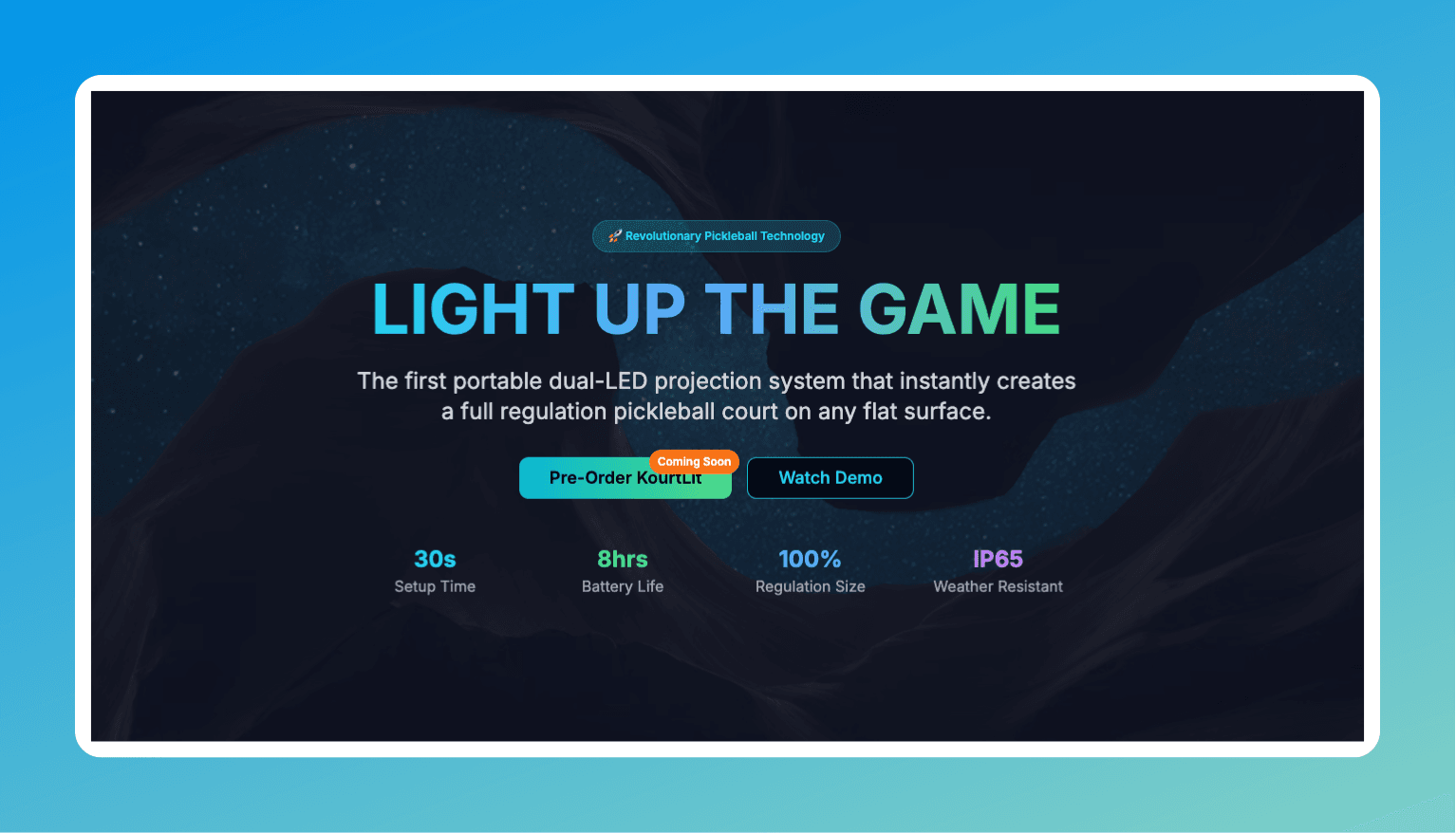
If surface selection, construction costs, and maintenance schedules sound overwhelming, there is another path entirely: skip the dedicated surface and play on whatever flat area you already have. A clean driveway, parking area, or gym floor becomes a regulation pickleball court in 30 seconds with the KourtLit portable projection system.
LED projection technology creates precise, regulation court lines on any surface without tape, paint, or physical markings. The system is weather-resistant (IP65 rated), runs for 8+ hours on a single battery charge, and costs a fraction of any permanent surface installation. For a detailed comparison, see our KourtLit vs Permanent Courts analysis.
Expert Recommendations by Use Case
- Home recreational court: Modular tiles over an existing concrete pad. Best balance of comfort, cost, and ease of installation. Or skip construction entirely with KourtLit.
- Community or HOA facility: Concrete base with standard acrylic coating. Durable enough for heavy use, professional appearance.
- Private club or training center: Concrete with cushioned acrylic. The premium surface for players who play daily and want maximum comfort.
- Public park or recreation department: Asphalt with standard acrylic. Lowest cost for multiple courts while still providing acceptable play quality.
- Temporary or event courts: Modular tiles or KourtLit projection. Both options can be set up and removed without any permanent modifications.