
DIY vs Professional Pickleball Courts
Should you build your own pickleball court or hire pros? Compare costs, quality, and long-term value.
Building a Pickleball Court: DIY or Professional?
The desire to have a dedicated pickleball court at home has grown enormously with the sport's popularity. Once you decide to build, the next question is whether to tackle it yourself or hire professionals. Both approaches have legitimate merits and significant drawbacks. This guide provides an honest, detailed analysis of costs, quality, timeline, and long-term maintenance for each path, plus a third option that avoids construction entirely.
Before diving into construction details, make sure you understand the official court dimensions and surface options so you know exactly what you are building.
Cost Comparison: 2025 Numbers
Cost is almost always the primary factor in the DIY-versus-professional decision. Here is what each approach realistically costs based on current material and labor pricing.
DIY Court Cost Breakdown
Professional Court Cost Breakdown
Hidden DIY Costs to Budget For
The cost ranges above assume everything goes according to plan. In reality, DIY projects frequently encounter unexpected expenses: equipment rental overruns, material waste from inexperience, drainage corrections, surface leveling issues, and the value of your own time. Many DIY builders report spending 40 to 60 percent more than their initial estimates.
Quality Comparison
The quality gap between DIY and professional construction is significant and affects your playing experience for years to come.
DIY Quality Factors
- Surface levelness: The single biggest challenge. Even small variations (1/8 inch over 10 feet) affect ball bounce predictability. Professional tools like laser screeds produce results that hand tools simply cannot match.
- Drainage: Proper grading requires precise slope calculations. DIY drainage errors lead to puddles, standing water, and accelerated surface deterioration.
- Line accuracy: Marking regulation lines requires careful measurement and steady application. Small errors compound across the 44-foot court length.
- Durability: Concrete mixing ratios, compaction of the sub-base, and curing conditions all affect longevity. Professionals have experience optimizing each variable.
Professional Quality Factors
- Precision equipment: Laser-guided grading, machine-controlled concrete pouring, and professional spray systems produce consistently flat, properly sloped surfaces.
- Material expertise: Professionals know which concrete mix, which acrylic system, and which sub-base material works best for your specific soil and climate conditions.
- Warranty protection: Most professional installations include 1 to 5 year warranties on materials and workmanship, giving you recourse if problems develop.
- Code compliance: Professionals handle permits, setback requirements, drainage regulations, and HOA approval processes.
Timeline Comparison
DIY Timeline
- Planning and permits: 2 to 6 weeks
- Site preparation: 1 to 3 weekends
- Sub-base installation: 1 to 2 weekends
- Surface pouring: 1 weekend
- Curing: 7 to 28 days
- Surface coating and lines: 1 to 2 weekends
- Total: 6 to 16 weeks
Professional Timeline
- Consultation and quotes: 1 to 2 weeks
- Permits: 2 to 4 weeks
- Site prep and sub-base: 2 to 5 days
- Surface installation: 1 to 3 days
- Curing: 7 to 28 days
- Coating and lines: 2 to 3 days
- Total: 4 to 8 weeks
Long-Term Maintenance Costs
Regardless of who builds the court, ongoing maintenance is unavoidable. The surface will degrade over time from weather, UV exposure, and use. Here is what to expect over a 10-year period.
10-Year Maintenance Schedule
- Annual cleaning and inspection: $100 to $200 (DIY-able with a pressure washer and inspection checklist)
- Crack repair (years 3 to 5): $200 to $500 per occurrence
- Line repainting (every 2 to 3 years): $200 to $500 DIY, $500 to $1,000 professional
- Surface resurfacing (years 5 to 8): $2,000 to $4,000 professional
- Net replacement (every 3 to 5 years): $150 to $400
- Fence repairs: $200 to $500 as needed
Estimated 10-year maintenance total: $5,000 to $10,000
When DIY Makes Sense
- Converting an existing slab: If you already have a flat concrete pad (old basketball court, large patio, or clean garage floor), a DIY conversion is straightforward and cost-effective. You only need to add lines and a net.
- Temporary or seasonal use: If you only want a court for part of the year, DIY tape lines or removable modular tiles on an existing surface make sense.
- Experience with concrete work: If you or a friend have professional construction experience, the quality gap narrows significantly.
- Strict budget under $5,000: DIY is the only way to get a dedicated court at this price point.
When to Hire Professionals
- New construction on raw ground: Excavation, sub-base preparation, and concrete pouring require equipment and expertise that most homeowners lack.
- Drainage challenges: Sloped yards, clay soil, or high water tables require professional grading and drainage solutions.
- HOA or permit complexity: If your area requires engineering drawings, environmental assessments, or HOA design approval, a professional handles these more efficiently.
- Tournament-quality surface: If you want a court that plays like a professional facility, professional installation with cushioned acrylic is the only reliable path.
- Property value consideration: A professionally built court adds more resale value than a DIY version, and buyers or inspectors can usually tell the difference.
The Third Option: Skip Construction Entirely
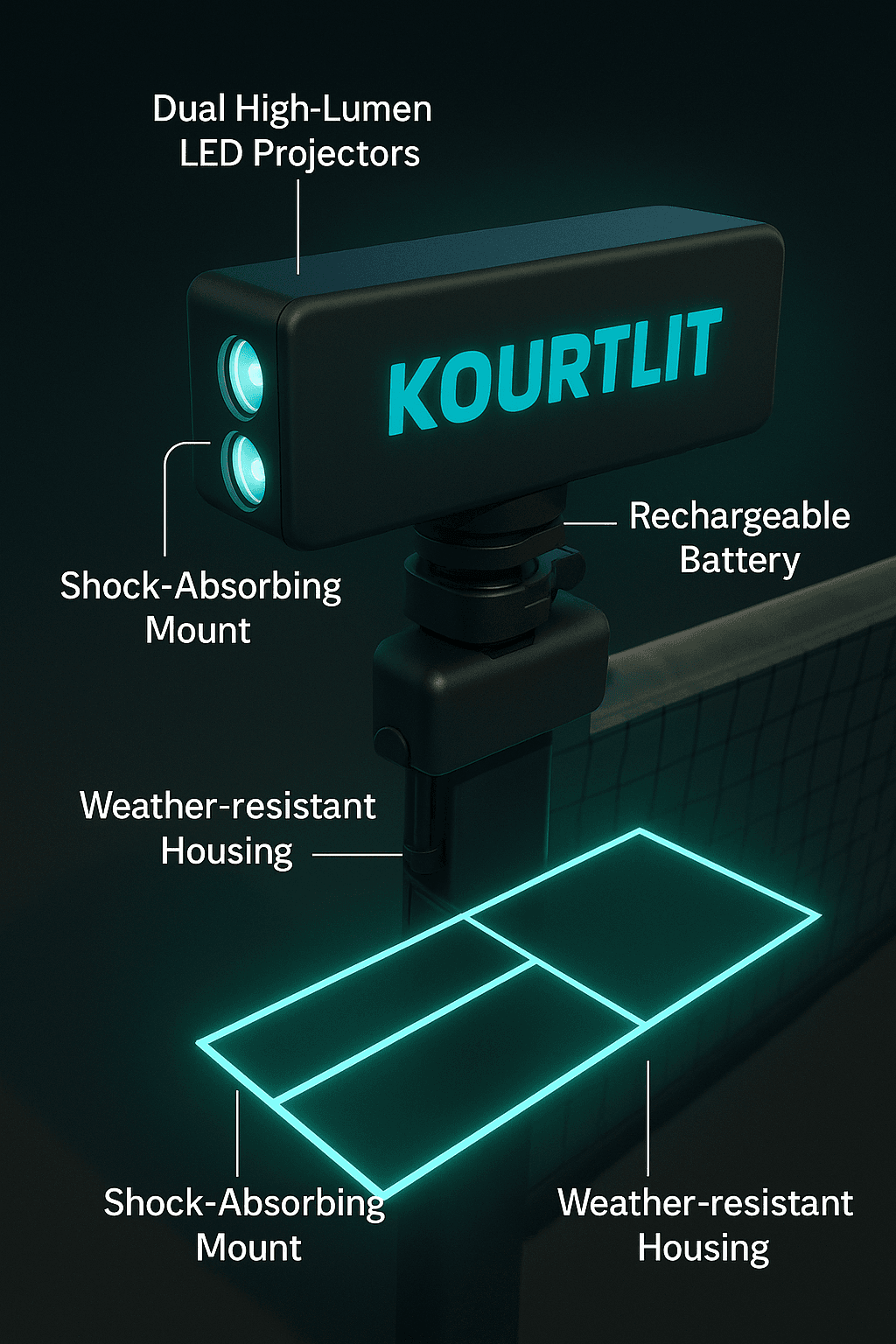
There is a growing third path that avoids the cost, complexity, and permanence of both DIY and professional construction. Portable court projection systems use LED technology to cast precise regulation lines onto any flat surface, converting a driveway, parking area, or gym floor into a pickleball court in seconds.
Why Players Are Choosing Portable Systems
- Cost: $2,999 for the KourtLit system versus $3,000 to $40,000+ for construction
- Time: 30-second setup versus weeks or months of construction
- Zero maintenance: No resurfacing, repainting, crack repair, or drainage management
- Total flexibility: Play at home today, at a friend's house tomorrow, at a park next weekend
- No permits: No construction means no building permits, no HOA approval, no setback requirements
- Perfect lines always: LED projection ensures exact regulation dimensions without human measurement error
For a detailed cost and performance comparison, read our KourtLit vs Permanent Courts guide. Explore the full feature set on our features page or see the system in action on our how it works page.